History
Tarihçe
Founded in 2006, and for sixteen years housed on the south campus of Boğaziçi University.
2006'da kuruldu ve on altı yıl boyunca Boğaziçi Üniversitesi Güney Kampüsü'nde faaliyet gösterdi.
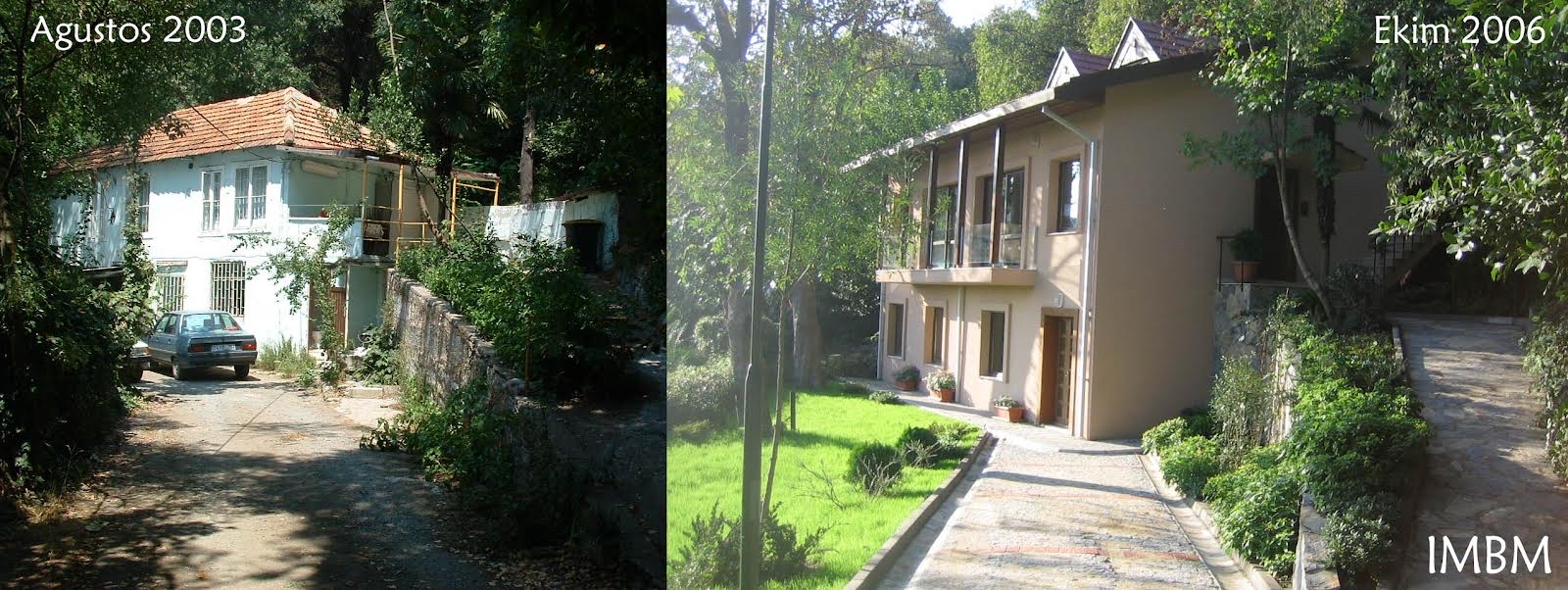
The founding, 2006
IMBM was founded in 2006 on the south campus of Boğaziçi University, through the collaboration of mathematics departments across Istanbul and the conditional donation of a private company, which rebuilt a derelict staff lodging for the purpose. The agreement committed the university, in writing, to the building’s use by the centre süresiz olarak — indefinitely.
It began with a mistake. Early in 2003 Cem Yalçın Yıldırım and Dan Goldston believed they had proved a result on the gaps between prime numbers. Hugh Montgomery described it at Oberwolfach as a remarkable result; within days the news had travelled from a village of a few hundred people to the front page of the New York Times, and from there back to Boğaziçi. On 27 March, persuaded to speak at the Wednesday colloquium before he was certain of the proof, Yıldırım drew a crowd the seminar room could not hold; they moved to the amphitheatre and filled it. The rector, Sabih Tansal, sat listening beside Erdal İnönü. Over tea afterwards Tanbay raised the idea of a mathematics centre and found him warm to it, and the following week he walked her across the campus to a derelict staff lodging — a gecekondu, of the kind Istanbul builds overnight — and said: find the money for the repairs, and build your centre there. The New York Times was by then reporting that the proof had a gap in it.
What followed was given rather than bought. Ertur Yener, an Aga Khan Award winner and one of Turkey's best architects, drew the plans as a gift — the first the centre received. David Mumford, in Turkey to give a Cahit Arf lecture at METU, saw the ruin and the country's potential, wrote letters, approached the World Bank and joined the scientific advisory committee. Victor Kac was as enthusiastic. John Pym, a visitor to Boğaziçi for years, gave books; Matematik Dünyası gave its bound volumes.
The first event was a workshop on small gaps between primes, held from 9 to 13 October 2006, at which Dan Goldston and János Pintz lectured on their joint work with Cem Yalçın Yıldırım. The centre opened formally later that month. The mathematicians of Istanbul were there, with the rectors of Boğaziçi, Koç and Sabancı; so were the donors of the building, the construction engineer Şarık Tara and the architect Ertur Yener, both since died. Pierre-Louis Lions spoke in November; by December the geometry-topology and physics seminars had begun meeting there, with a note on the poster reading “this is going to be our first meeting at the new center”.

Betül Tanbay, one of the founders and a co-director from 2006 to 2012, wrote an account of those years for the EMS Newsletter — “Centres: IMBM”, issue 77, September 2010, page 49. She had told the same story in Turkish four years earlier, in Matematik Dünyası 2006-IV — the issue in which both photographs on this page appeared.
What it was for
Its first years were carried by a doctoral network. From January 2008 Boğaziçi, Koç and Sabancı were partners in TÜBİTAK's İŞBAP programme for doctoral and postdoctoral research in mathematics, in which the centre was entered as an in-kind contribution. Until the programme ended early in 2012, most of what happened at IMBM drew on it, and the network's researchers met there twice a term. Boğaziçi paid for the rest: the building and its garden, the guesthouse, and the tea and coffee at every talk.
In 2011–12 a small building beside the centre was rebuilt as a guesthouse, under a donation agreement between the rector and the chairman of ENKA — two rooms and a sitting room, set aside first for IMBM's visitors. While ENKA's team was on site they repainted and renovated the centre's own building too, and the talks carried on throughout. The centre also took a part in basic-science policy, twice convening meetings on a proposed TÜBİTAK–Boğaziçi Feza Gürsey Institute; some forty scientists came to the second, on 2 December 2011, with the rector, Kadri Özçaldıran. Three weeks later, on 23 December, the steering and management committees met together and decided to restructure the centre from October 2012.
The centre had no curriculum and awarded no degrees. Its purpose was narrower and harder to arrange: to give mathematicians somewhere to work together for a few days or a few weeks. The archive records two hundred and thirty-six such visits — a host at a Turkish university, one or more guests from elsewhere, and a project they had come to pursue. Alongside them ran the seminars.
Sixteen series met at IMBM over the years, several of them for a decade or more: the Mathematical and Theoretical Physics Afternoons from 2006, the Discrete Mathematics Days from 2009, the graph theory workshops and Mathematics Days from 2012, Models and Groups and also Women and Mathematics from 2013, the Geometry/Topology Meetings from 2014. Some were founded there; others moved in.
The centre is an associate member of ERCOM, the European Mathematical Society’s committee of European Research Centres on Mathematics, and was one of twenty-eight institutes included in MATHE-I, the European mathematics infrastructure project prepared for the European Commission. It was chosen after a visit in 2009–10 by the President of the European Mathematical Society, Ari Laptev, and the Society's executive committee, to whom the centre presented its reports; the same year the Society's committee for raising public awareness of mathematics held its annual meeting at IMBM.
Who came
The archive holds more than a thousand talks, by some seven hundred mathematicians, from over four hundred institutions. Among those who came to Istanbul to give them:
- Pierre-Louis LionsFields Medal2006
- Victor KacWolf Prize2007
- Luis CaffarelliAbel Prize2007
- Gang Tian2009
- Ben Green2009
- Robin Wilson2010
- David Gabai2010
- John Morgan2010
- Vladimir VoevodskyFields Medal2015
- Bernd Sturmfels2019
- Geordie Williamson2019
- George LusztigWolf Prize2025
- Cédric VillaniFields Medal2026
Others of that standing have addressed the centre without travelling to it, through the Turkish Mathematical Society’s distinguished colloquium series, which has been held online since the pandemic:
- Alessio FigalliFields Medal2022
- Karen UhlenbeckAbel Prize2022
- Ingrid DaubechiesWolf Prize2023
- Larry Guth2023
- Tobias Colding2023
Others returned so often that they are better described as part of the place than as visitors. Edriss Titi spoke seven times between 2007 and 2024, on both sides of the eviction. Nikolai Nikolski gave eleven lectures across two visits, in 2008 and 2010. Henning Samtleben taught three separate courses there, in three consecutive Februaries. Vladimir Voevodsky was planning a three-week visit, had life permitted it.
Not all of it was in English. Talks have been given in Turkish throughout — on graph theory, on the four colour theorem, on Noether’s theorem, on Lorentz geometry — which is worth saying plainly, because an institute that works in two languages is doing something a little different from one that works in one.
Some of that work was not for mathematicians only. In 2015 the IMAGINARY exhibition came to Turkey, a project led by the Turkish Mathematical Society on which the centre advised. Over four years it reached eighteen cities, from Istanbul to Bayburt, Artvin and Van.
May 2022
On 5 May 2022 the rectorate gave the centre ten days to vacate the building, reassigning it to two administrative offices. Requests for a meeting went unanswered. On the morning of 24 May 2022 the locks were changed.
The last talk given in the building was on 13 May, when Ramesh Sreekantan spoke twice in one day on algebraic cycles. Rosa Winter’s seminar a fortnight later was announced as online only.
The centre put it this way at the time: “IMBM is the only research institute in Turkey — in the region, even — covering every field of the mathematical sciences. An eviction, which would mean the disappearance of the centre, would seriously harm the whole mathematical community, and the Boğaziçi mathematics department above all.”
Since
The centre did not stop. In the first year after the locks were changed, from May 2022 to May 2023, thirty activities were held — five meetings and twenty-five talks, twelve of them given at other institutions in its support — and they took place in every way but one: on Zoom and Microsoft Teams, in room TB 130 and room TB 310 of the Faculty of Arts and Sciences at Boğaziçi University, at Minerva Han in Karaköy, and in the Cahit Arf Amphitheatre of the Middle East Technical University in Ankara. Visitors from outside Boğaziçi now fill in a form to get through the campus gate.
Soon after, the centre asked mathematicians everywhere to declare a seminar at their own institution an “IMBM Seminar” in its support. Twelve were reported in June and July 2022 — in Lyon, London, Vienna, Montpellier and Podgorica, and at METU, MSGSÜ and Boğaziçi — and are listed under Support IMBM.
In October 2022 the sixth Mathematics Days were held at Minerva Han. In March 2023 the Women and Mathematics meeting — a series IMBM had hosted since 2013 — was held at METU in Ankara, still announced as an IMBM event: Bu bir İMBM etkinliğidir.
That is what the loss of a building costs. The centre still has its name, its directors and its community. What it no longer has is a room in which they can all be at once.
In March 2026, as part of the centre’s twentieth-year events, Cédric Villani gave a talk in TB 310 — almost twenty years after his doctoral adviser Pierre-Louis Lions had spoken at IMBM. The room was free only because an instructor who normally taught a class in it gave it up.
In May 2026 it ran a four-day conference on contact topology and mapping class groups, with eight invited speakers, ten lightning talks by doctoral students, and funding from TÜBİTAK and the Turkish Mathematical Society — in a borrowed lecture hall.
The donor has twice served formal notice on the university through a notary, requiring that the building be returned to the centre’s use in accordance with the donation agreement. Science academies around the world, among them the Académie des Sciences, and mathematical societies including the International Mathematical Union, protested at the seizure of the building.

Kuruluş, 2006
IMBM 2006 yılında, Boğaziçi Üniversitesi Güney Kampüsü'nde, İstanbul'daki matematik bölümlerinin işbirliğiyle ve özel bir şirketin şartlı bağışıyla kuruldu; şirket bu amaçla harap hâldeki bir lojmanı yeniden yaptırdı. Bağış sözleşmesi üniversiteyi, binanın merkez tarafından süresiz olarak kullanılmasına yazılı olarak bağlıyordu.
Her şey bir yanlışla başladı. 2003'ün başında Cem Yalçın Yıldırım ile Dan Goldston, asal sayılar arasındaki boşluklar üzerine bir sonuç kanıtladıklarına inandılar. Hugh Montgomery Oberwolfach'ta bunu müthiş bir sonuç diye anlattı; haber birkaç yüz kişilik bir köyden New York Times'ın birinci sayfasına, oradan da Boğaziçi'ne döndü. 27 Mart'ta, kanıttan henüz emin değilken çarşamba kolokyumunda konuşmaya ikna edilen Yıldırım'ı dinlemeye gelenleri küçücük seminer odası almıyordu; anfiye geçtiler ve anfiyi doldurdular. Rektör Sabih Tansal da oradaydı, Erdal İnönü'yle yan yana. Konuşma sonrası çay içerken Tanbay lafı bir matematik merkezi kurmaya getirdi ve çok olumlu bir tepki buldu. Ertesi hafta Tansal onu kampüste bir gecekonduya götürdü: tadilat parasını bulursanız, merkezinizi burada yapın, dedi. New York Times o sıralarda kanıtta bir açık olduğunu yazıyordu.
Sonrası satın alınmadı, verildi. Ağa Han Ödülü sahibi, Türkiye'nin en iyi mimarlarından Ertur Yener projeyi hediye etti — merkeze verilen ilk hediye. ODTÜ'ye Cahit Arf konuşması için gelen David Mumford gecekonduyu ve bu ülkenin potansiyelini gördü; yazı yazdı, Dünya Bankası'ndan destek için girişimde bulundu ve bilimsel danışma komitesinde yer almayı kabul etti. Victor Kac aynı coşkuyu gösterdi. Yıllardır Boğaziçi'ni ziyaret eden John Pym kitap bağışladı; Matematik Dünyası ciltlenmiş dergilerini verdi.
İlk etkinlik, 9–13 Ekim 2006 tarihlerinde yapılan asal sayılar arasındaki küçük boşluklar çalıştayıydı; Dan Goldston ve János Pintz, Cem Yalçın Yıldırım'la ortak çalışmalarını anlattılar. Merkez aynı ay içinde resmen açıldı. Açılışta İstanbul'un matematikçileri, Boğaziçi, Koç ve Sabancı rektörleri ve binanın bağışçıları — inşaat mühendisi Şarık Tara ile mimar Ertur Yener, ikisi de artık aramızda değil — hazır bulundu. Kasım'da Pierre-Louis Lions konuştu; Aralık'ta geometri-topoloji ve fizik seminerleri burada toplanmaya başladı — afişteki not şöyleydi: “Bu toplantı yeni merkezdeki ilk toplantımız olacak.”
Kurucularından ve 2006–2012 arasında eş yöneticilerinden Betül Tanbay, o yılların hikâyesini EMS Newsletter için yazmıştır — “Centres: IMBM”, sayı 77, Eylül 2010, sayfa 49. Aynı hikâyeyi dört yıl önce Türkçe olarak da anlatmıştı: Matematik Dünyası 2006-IV — bu sayfadaki iki fotoğrafın da yer aldığı sayı.
Ne işe yarıyordu
İlk yıllarını bir doktora ağı taşıdı. Ocak 2008'den itibaren Boğaziçi, Koç ve Sabancı, TÜBİTAK'ın İŞBAP programı kapsamındaki matematik doktora ve doktora sonrası araştırma işbirliği ağının katılımcısıydı; merkez başvuruda ayni katkı olarak gösterilmişti. Program 2012'nin başında sona erene dek IMBM'deki faaliyetlerin çoğu bu projeden destek aldı ve ağın araştırmacıları her dönem iki kez merkezde buluştu. Gerisini Boğaziçi karşıladı: bina ve bahçesinin bakımı, misafirhane ve her konuşmadaki çay-kahve.
2011–12'de merkezin yanındaki küçük bina, rektör ile ENKA Yönetim Kurulu Başkanı arasında imzalanan şartlı bir bağış anlaşmasıyla misafirhane olarak yeniden yapıldı: iki oda ve bir salondan oluşan, öncelikle IMBM'nin konuklarına ayrılmış bir yer. ENKA ekibi oradayken IMBM binasının da genel bakımını, boyasını ve tadilatını yaptı; konuşmalara ara verilmedi. Merkez temel bilim politikalarında da rol aldı ve önerilen TÜBİTAK–Boğaziçi Feza Gürsey Enstitüsü üzerine iki kez toplantı düzenledi; 2 Aralık 2011'deki ikincisine kırk kadar bilim insanıyla birlikte rektör Kadri Özçaldıran da katıldı. Üç hafta sonra, 23 Aralık'ta, bilimsel yönlendirme ve işletme komiteleri bir araya gelerek merkezi Ekim 2012'den itibaren yeniden yapılandırma kararı aldı.
Merkezin ders programı yoktu, diploma vermiyordu. Amacı daha dar ve düzenlenmesi daha zordu: matematikçilere birkaç gün ya da birkaç hafta birlikte çalışabilecekleri bir yer vermek. Arşivde bu türden iki yüz otuz altı ziyaret kayıtlı — Türkiye'deki bir üniversiteden bir ev sahibi, başka yerlerden bir ya da daha fazla konuk, ve peşine düştükleri bir problem. Yanı sıra seminerler yürüyordu.
Yıllar içinde merkezde on altı dizi toplandı; birçoğu on yıl ya da daha uzun sürdü: 2006'dan beri Matematiksel ve Teorik Fizik Öğleden Sonraları, 2009'dan beri Ayrık Matematik Günleri, 2012'den beri çizge kuramı çalıştayları ve Matematik Günleri, 2013'ten beri Modeller ve Gruplar ile yine 2013'ten beri Kadın ve Matematik, 2014'ten beri Geometri/Topoloji Buluşmaları. Bazıları burada kuruldu, bazıları buraya taşındı.
Merkez, Avrupa Matematik Derneği’nin Avrupa matematik araştırma merkezleri komitesi ERCOM’un asosye üyesidir; ayrıca Avrupa Komisyonu için hazırlanan MATHE-I Avrupa matematik altyapısı projesine dahil edilen yirmi sekiz enstitüden biridir. Bu seçim, Avrupa Matematik Derneği Başkanı Ari Laptev ile derneğin yönetim kurulunun 2009–10'da merkezi ziyaret etmesi ve kendilerine faaliyet raporlarının sunulmasının ardından geldi; aynı yıl derneğin matematiğin kamuoyunda tanıtılması komitesi de yıllık toplantısını IMBM'de yaptı.
Kimler geldi
Arşivde dört yüzü aşkın kurumdan, yedi yüz kadar matematikçinin verdiği binden fazla konuşma var. Konuşmak için İstanbul'a gelenler arasında:
- Pierre-Louis LionsFields Madalyası2006
- Victor KacWolf Ödülü2007
- Luis CaffarelliAbel Ödülü2007
- Gang Tian2009
- Ben Green2009
- Robin Wilson2010
- David Gabai2010
- John Morgan2010
- Vladimir VoevodskyFields Madalyası2015
- Bernd Sturmfels2019
- Geordie Williamson2019
- George LusztigWolf Ödülü2025
- Cédric VillaniFields Madalyası2026
Aynı çapta başka isimler de, merkeze gelmeden, Türk Matematik Derneği'nin pandemiden bu yana çevrimiçi yapılan seçkin seminerler dizisi aracılığıyla konuştu:
- Alessio FigalliFields Madalyası2022
- Karen UhlenbeckAbel Ödülü2022
- Ingrid DaubechiesWolf Ödülü2023
- Larry Guth2023
- Tobias Colding2023
Bazıları o kadar sık döndü ki artık ziyaretçi değil, mekânın bir parçası sayılırlar. Edriss Titi 2007 ile 2024 arasında yedi kez konuştu — tahliyenin iki yakasında da. Nikolai Nikolski 2008 ve 2010'daki iki ziyaretinde on bir ders verdi. Henning Samtleben art arda üç şubatta üç ayrı ders dizisi yürüttü. Vladimir Voevodsky üç haftalık bir ziyaret planlıyordu; ömrü yetmedi.
Hepsi İngilizce değildi. Baştan beri Türkçe konuşmalar da yapıldı — çizge kuramı üzerine, dört renk teoremi üzerine, Noether teoremleri üzerine, Lorentz geometrisi üzerine. Bunu açıkça söylemekte yarar var: iki dilde çalışan bir enstitü, tek dilde çalışandan biraz farklı bir iş yapıyor demektir.
Bu işin bir kısmı yalnızca matematikçilere yönelik değildi. 2015'te IMAGINARY sergisi Türkiye'ye geldi; Türk Matematik Derneği'nin yürüttüğü, merkezin bilimsel danışmanlık yaptığı bu proje dört yılda on sekiz şehre ulaştı — İstanbul'dan Bayburt'a, Artvin'e ve Van'a.
Mayıs 2022
5 Mayıs 2022'de rektörlük merkeze binayı boşaltması için on gün süre verdi; bina iki idari birime tahsis edildi. Görüşme talepleri yanıtsız kaldı. 24 Mayıs 2022 sabahı kilitler değiştirildi.
Binada verilen son konuşma 13 Mayıs'taydı: Ramesh Sreekantan aynı gün cebirsel çevrimler üzerine iki seminer verdi. Rosa Winter'ın iki hafta sonraki semineri yalnızca çevrimiçi olarak duyuruldu.
Merkez o dönemde şunu belirtmiştir: “IMBM, matematiksel bilimlerin tüm alanlarını kapsayan Türkiye'deki, hatta bölgedeki tek araştırma enstitüsüdür. Merkezin ortadan kaybolması anlamına gelecek olan bir tahliye, başta Boğaziçi Matematik Bölümü olmak üzere tüm matematik camiasını ciddi anlamda olumsuz etkileyecektir.”
O günden beri
Merkez durmadı. Kilitlerin değiştirilmesini izleyen ilk yılda, Mayıs 2022'den Mayıs 2023'e kadar, otuz etkinlik yapıldı — beş toplantı ve yirmi beş konuşma; konuşmaların on ikisi merkeze destek için başka kurumlarda verildi. Etkinlikler, biri dışında her yolla gerçekleşti: Zoom ve Microsoft Teams üzerinde, Boğaziçi Üniversitesi Fen-Edebiyat Fakültesi'nin TB 130 ve TB 310 numaralı odalarında, Karaköy'deki Minerva Han'da ve Ortadoğu Teknik Üniversitesi'ndeki Cahit Arf Amfisi'nde. Boğaziçi dışından gelenler artık kampüs kapısından geçebilmek için form dolduruyor.
Kısa süre sonra merkez, her yerdeki matematikçilere kendi kurumlarındaki bir etkinliğe destek için “IMBM etkinliği” demelerini önerdi. Haziran ve Temmuz 2022’de on iki seminer bildirildi — Lyon, Londra, Viyana, Montpellier ve Podgorica’da; ODTÜ, MSGSÜ ve Boğaziçi’nde — ve IMBM’ye Destek altında listeleniyor.
Ekim 2022'de altıncı Matematik Günleri Minerva Han'da yapıldı. Mart 2023'te Kadın ve Matematik toplantısı — IMBM'nin 2013'ten beri ev sahipliği yaptığı bir dizi — Ankara'da ODTÜ'de yapıldı; yine de bir IMBM etkinliği olarak duyuruldu: Bu bir İMBM etkinliğidir.
Bir binanın kaybının bedeli budur. Merkezin adı, yöneticileri ve camiası duruyor. Artık olmayan şey, hepsinin aynı anda içinde bulunabileceği bir oda.
Mart 2026'da, merkezin yirminci yıl etkinlikleri kapsamında, Cédric Villani TB 310'da bir konuşma yaptı — doktora danışmanı Pierre-Louis Lions'ın İMBM'de konuşmasından neredeyse yirmi yıl sonra. Oda, normalde orada dersi olan bir öğretim elemanının dersinden vazgeçmesi sayesinde boştu.
Mayıs 2026'da merkez, kontakt topoloji ve sınıf gruplama üzerine dört günlük bir konferans düzenledi: sekiz davetli konuşmacı, doktora öğrencilerinin verdiği on kısa konuşma, TÜBİTAK ve Türk Matematik Derneği desteği — ödünç alınmış bir derslikte.
Bağışçı, bağış sözleşmesi uyarınca binanın merkezin kullanımına iade edilmesi için üniversiteye noter aracılığıyla iki kez ihtarname göndermiştir. Binaya el konulmasına, aralarında Académie des Sciences'ın da bulunduğu bilim akademileri ve Uluslararası Matematik Birliği başta olmak üzere matematik dernekleri dünya çapında tepki gösterdi.